Mortgage rates are back above 7%.
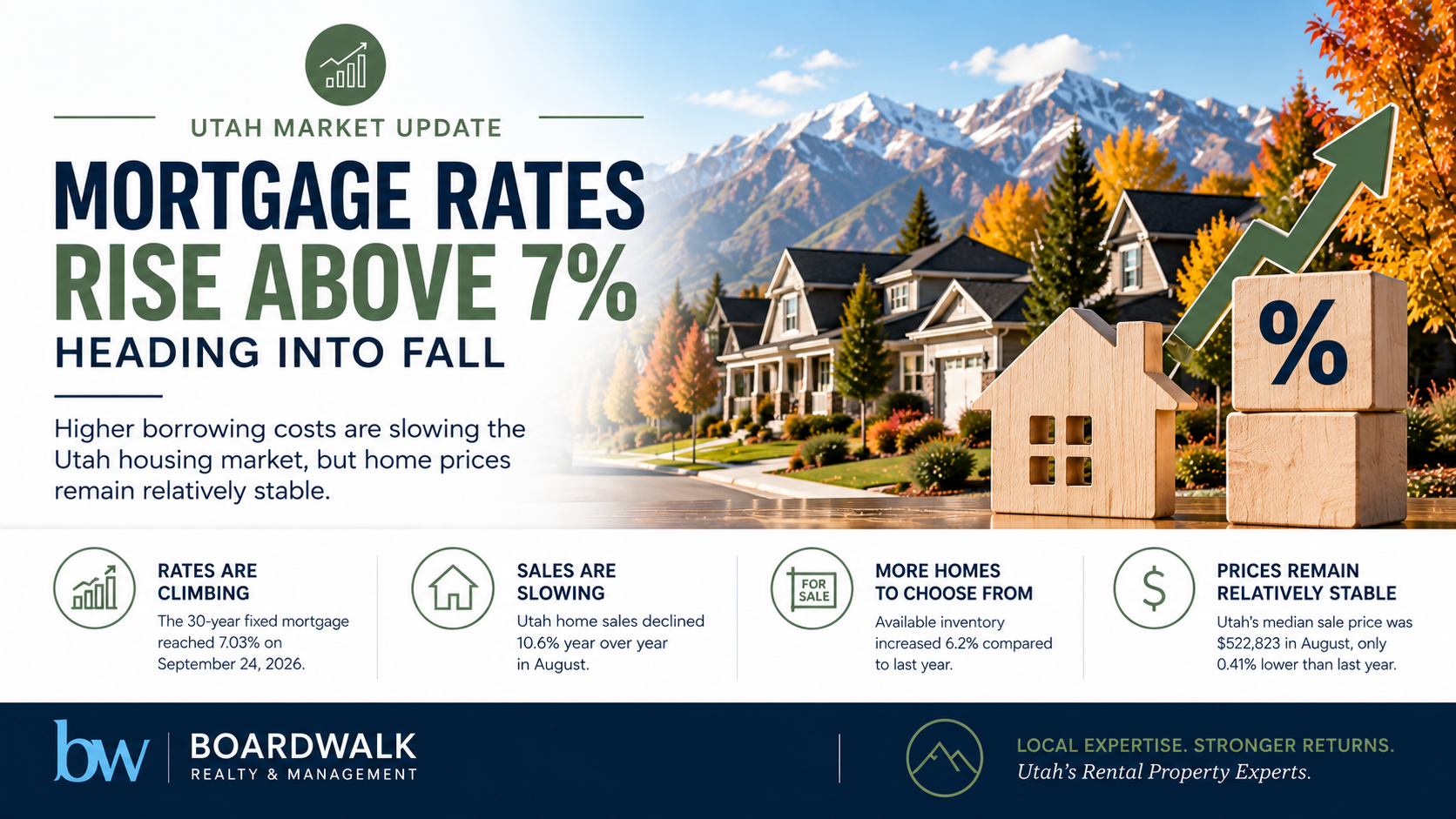
According to Freddie Mac, the average 30-year fixed mortgage reached 7.03% on September 24, 2026, continuing a noticeable climb during September.
For Utah's housing market, the important story isn't simply that rates crossed 7%.
It's what those higher borrowing costs are doing to buyers, sellers, and real estate investors.
Home sales are slowing. Inventory is increasing. Properties are taking longer to sell.
But Utah home prices haven't experienced a dramatic decline.
Instead, we're entering a slower and more selective housing market—one where financing costs, accurate pricing, negotiation, and cash flow matter more than they did during the ultra-competitive years.
Here's what Utah property owners and investors should know heading into fall.
Mortgage Rates Have Moved Higher Quickly
The change has happened over a relatively short period.
Freddie Mac's weekly mortgage survey reported the following average 30-year fixed rates:
August 27: 6.66%
September 3: 6.71%
September 10: 6.76%
September 17: 6.95%
September 24: 7.03%
The 15-year fixed mortgage also reached 6.42% on September 24.
That means the average 30-year rate increased by approximately 0.37 percentage points in less than a month.
That may not sound dramatic.
But when you're financing hundreds of thousands of dollars, relatively small changes in interest rates can have a meaningful effect on monthly payments.
Why 7% Matters to Buyers
Mortgage rates directly affect purchasing power.
The higher the interest rate, the more expensive it becomes to finance the same property.
For example, Freddie Mac illustrates that principal-and-interest payments on a $300,000 mortgage would be approximately:
At 6.5%: $1,896 per month
At 7.0%: $1,996 per month
At 7.5%: $2,098 per month
And that's before adding property taxes, homeowners insurance, HOA expenses, or other ownership costs.
For buyers already stretching their budgets, another increase in rates can change what they can realistically afford.
The property price may not have changed—but the cost of owning it has.
Utah Home Sales Are Slowing
Higher financing costs are arriving at a time when Utah's housing market is already experiencing lower transaction volume.
According to Redfin's August 2026 statewide data, approximately 2,954 homes sold in Utah.
That's 10.6% fewer sales than a year earlier.
The typical Utah home also spent approximately 55 days on the market, about three days longer than last year.
Those numbers point toward a market where buyers are becoming more selective.
But here's the important distinction:
Lower sales activity hasn't produced a dramatic decline in Utah home values.
Utah Home Prices Are Essentially Flat
Utah's statewide median sale price was approximately:
$522,823
in August 2026.
That's only 0.41% lower than a year earlier.
So while the number of transactions dropped by more than 10%, prices were essentially flat.
That's an important difference.
A slowdown in sales doesn't automatically mean a collapse in property values.
Right now, the Utah market looks more like a period of lower transaction volume and price stabilization than a major correction.
Buyers Have More Homes to Choose From
Another significant change is inventory.
Approximately 19,304 homes were for sale across Utah in August, according to Redfin.
That's 6.2% more than a year earlier.
New listings were also up approximately 4.9%, and Utah had roughly five months of housing supply.
More inventory changes the dynamics of the market.
Buyers may have:
- More properties to compare
- More time to make decisions
- Less pressure to immediately submit an offer
- More opportunities to negotiate
- Greater ability to request concessions or repairs
This is very different from the market conditions buyers experienced when multiple offers and rapid sales were much more common.
Higher Rates Don't Automatically Mean Lower Prices
This is one of the most important concepts for property owners to understand.
It's tempting to assume:
Mortgage rates go up → home prices must go down.
Real estate markets aren't always that simple.
Higher rates can reduce purchasing power and slow demand.
But home values are also influenced by:
- Housing supply
- Local population growth
- Employment
- Household formation
- Seller motivation
- New construction
- Neighborhood demand
- Property condition
- Local inventory
That's why transactions can slow significantly while prices remain relatively stable.
And that's largely what Utah's current numbers are showing.
Salt Lake County Is Seeing the Same Pattern
Salt Lake County provides a good example.
Over the three months ending in August 2026, the county's median sale price was approximately:
$556,717
That's just 0.59% lower than a year earlier.
But sales activity tells a different story.
Approximately 921 homes sold in August, down 14.8% year over year.
Homes spent a median of approximately 48 days on the market, compared with 44 days a year earlier.
Again, the pattern is similar:
Sales are slowing much more dramatically than prices are falling.
What Does This Mean for Buyers?
There are two competing forces affecting buyers right now.
The good news:
More inventory can mean more choices.
Less competition can create negotiating opportunities.
Buyers may have more leverage on price, repairs, closing costs, or other concessions.
The challenge:
Financing has become more expensive.
A buyer may successfully negotiate thousands of dollars off a property's asking price but still face a higher monthly payment because of the mortgage rate.
That's why today's buyers need to evaluate more than the purchase price.
The total monthly cost of ownership matters.
What Does This Mean for Sellers?
Sellers are entering a market where pricing strategy matters more.
When buyers have more inventory to choose from, an overpriced property can be easier to skip.
Properties that don't compare favorably with competing listings may:
- Sit on the market longer
- Receive fewer offers
- Require price reductions
- Face more requests for concessions
That doesn't mean Utah sellers are necessarily in a weak position.
Prices remain relatively stable statewide.
But sellers may need to adjust expectations from the highly competitive markets of previous years.
Correct pricing and property presentation are becoming increasingly important.
What Does This Mean for Real Estate Investors?
For investors, rates above 7% make underwriting more important.
When financing becomes more expensive, a property that looked attractive at a lower rate may no longer produce the same cash flow.
Investors should pay close attention to:
- Mortgage payments
- Expected rental income
- Property taxes
- Insurance
- HOA expenses
- Maintenance
- Vacancy assumptions
- Property-management costs
- Capital expenditures
But a slower market can also create opportunities.
More inventory and longer marketing times may give qualified buyers additional negotiating leverage.
Depending on the property and seller, investors may be able to negotiate:
- Purchase price
- Closing-cost contributions
- Repairs
- Seller concessions
- Other favorable terms
Higher financing costs don't automatically eliminate investment opportunities—but they make disciplined analysis much more important.
Rental Demand Is Part of the Equation Too
Higher mortgage rates don't affect only home sales.
When purchasing a home becomes less affordable, some households may remain renters longer than they otherwise would.
That can support demand for rental housing.
But rental-property owners shouldn't interpret that as permission to ignore pricing or property quality.
Tenants face affordability pressures too.
Successful rental investments still depend on understanding:
- Local rental demand
- Comparable rents
- Vacancy
- Tenant retention
- Property condition
- Operating expenses
- Long-term neighborhood fundamentals
A strong rental property still needs to make sense as an investment.
A Slower Market Isn't Necessarily a Weak Market
It's important to separate market activity from property values.
Utah's latest data shows:
Mortgage rates: Higher
Home sales: Lower
Inventory: Higher
Days on market: Longer
Statewide prices: Relatively stable
That's not the profile of the ultra-competitive market Utah experienced several years ago.
But it's also not evidence of a dramatic housing collapse.
Instead, we're seeing a market that is becoming more selective.
Buyers have more choices.
Sellers need stronger pricing strategies.
And investors need to analyze deals more carefully.
The Bottom Line
Mortgage rates crossing 7% is significant—but the number alone doesn't tell the entire story.
Higher borrowing costs are making purchases more expensive and contributing to slower transaction volume across Utah.
At the same time, inventory is increasing and buyers have more negotiating opportunities.
Yet Utah home prices have remained relatively stable.
The result is a slower, more selective market—not necessarily a weak one.
For investors and property owners, this is a market where the fundamentals matter.
Location matters.
Purchase price matters.
Financing matters.
Rental income matters.
And good property management matters.
Rather than trying to predict exactly where mortgage rates or home prices will go next, owners and investors can focus on whether an individual property makes financial sense under today's conditions.
Navigate Utah's Changing Real Estate Market
Boardwalk Realty & Management works with Utah property owners and investors who want to protect and maximize the long-term performance of their rental properties.
Whether you're evaluating an investment, preparing a property for rent, or looking for professional management, our team can help you understand the local rental market and manage the property day to day.
Contact our team: Boardwalk Contact Us
Call: (801) 748-1044
Email: info@rentfromboardwalk.com
Learn more: Boardwalk Property Management Services
Looking for Utah real estate? Search Utah Houses
Market information reflects publicly available data as of September 28, 2026. Mortgage rates can change frequently and individual borrowers may receive rates that differ from published averages. Housing conditions also vary significantly by location, property type, price range, and data source. This article is for general informational purposes and is not financial, investment, lending, or legal advice.
Sources: Freddie Mac Primary Mortgage Market Survey and Redfin housing-market data.