
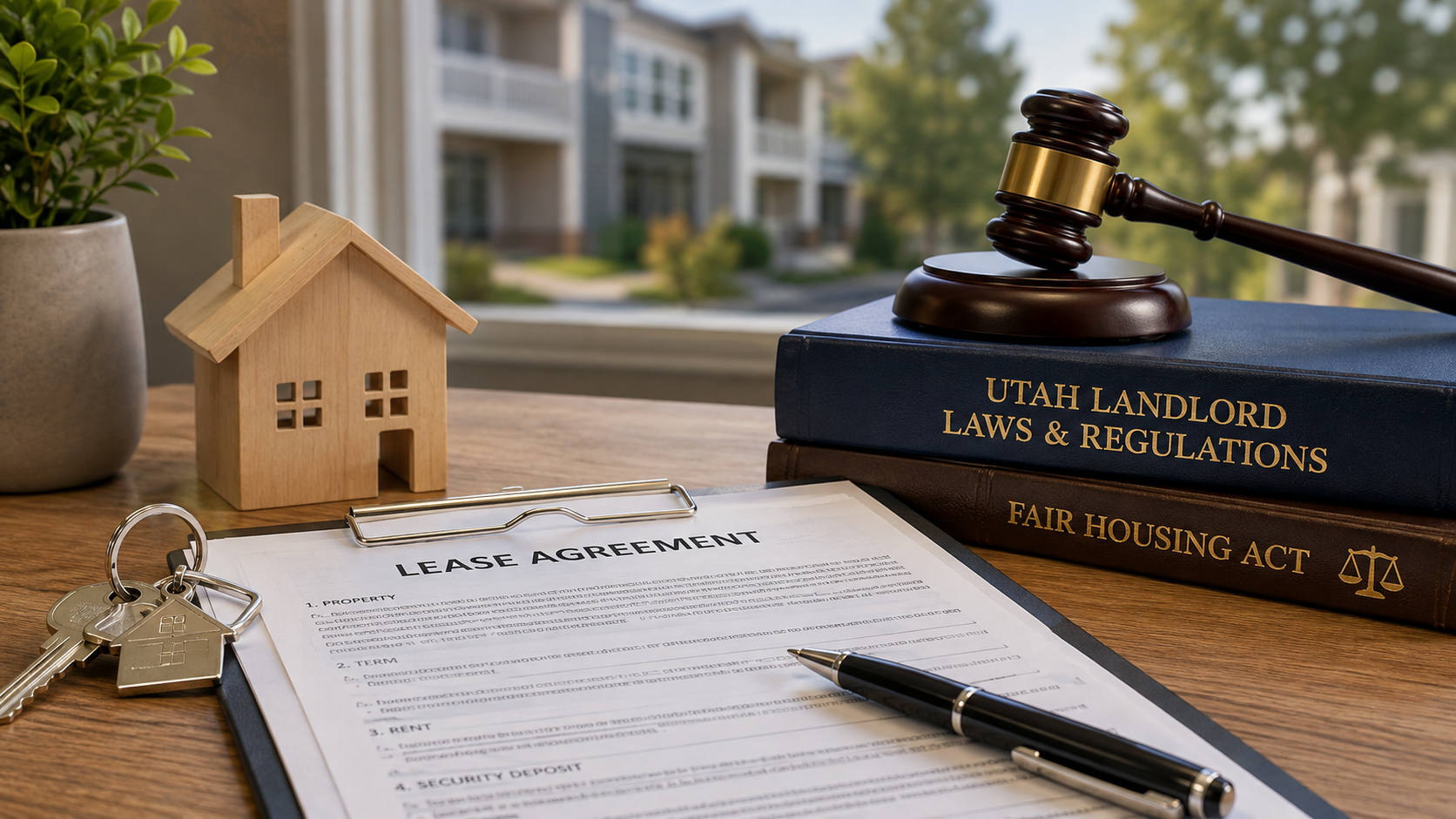
September is a good time for rental property owners to do something that often gets pushed aside during the busy leasing season:
review the legal and compliance side of the business.
There is not a major new Utah landlord law taking effect specifically on September 1, 2026. But several important legislative changes, existing deadlines, and recent enforcement actions are shaping how rental properties should be managed going forward.
For owners, the practical lesson is straightforward:
Small compliance mistakes can become expensive problems when they involve leases, deposits, notices, evictions, maintenance, or fair housing.
Here are the issues worth reviewing this month.
Utah Property Management Licensing Is Changing in 2027
One of the biggest changes affecting Utah's rental industry is already on the horizon.
During the 2026 legislative session, Utah lawmakers passed HB 377, Real Estate Amendments, which moved implementation of the state's new individual property-manager license to January 1, 2027.
The legislation further defines the scope of the property-manager license and addresses when property managers must be affiliated with a principal broker.
The Utah Division of Real Estate has also been developing the administrative rules and licensing framework needed for the transition.
Why does this matter to property owners?
If you hire a professional management company, licensing is one more piece of the due diligence that protects your investment.
Owners should understand:
- Who is actually managing the property
- What licensing applies to the people performing management activities
- How rent and owner funds are handled
- What systems are in place for leasing, maintenance, and compliance
For owners who self-manage, the change is also a useful reminder that Utah distinguishes between managing your own property and performing regulated real-estate or management activities for others.
January 2027 is approaching quickly, and professional management companies should already be preparing for the transition.
Security Deposits: The 30-Day Deadline Still Matters
Security deposits remain one of the easiest areas for an otherwise careful landlord to create unnecessary legal exposure.
Under current Utah law, no later than 30 days after a renter vacates and returns possession of the property, the owner or owner's agent generally must provide:
- The remaining balance of the security deposit
- Any remaining prepaid rent
- A written, itemized explanation of deductions
Utah law allows deposits to be applied toward items such as unpaid rent, damage beyond reasonable wear and tear, cleaning, and certain costs or fees authorized by the rental agreement.
But the key word is documented.
A security deposit should not be treated like a general pool of money that can simply be retained because a unit needed work after move-out.
Owners should be able to explain:
- What was damaged
- Why the tenant was responsible
- What amount was deducted
- How that amount was calculated
Good move-in and move-out photographs, invoices, inspection records, and written accounting can make an enormous difference if a deduction is later disputed.
Evictions: The Notice Is Part of the Case
When rent is unpaid or a serious lease violation occurs, owners sometimes focus entirely on the underlying problem.
But in an eviction case, the procedure matters too.
Utah Courts identifies a three-day notice to pay or vacate as the standard notice used in applicable nonpayment-of-rent situations.
The notice also has to be properly served.
That means an eviction is not simply:
"The tenant owes rent, so they have to leave."
There is a defined legal process.
If the matter becomes an unlawful-detainer case, documents such as the rental agreement, notices, payment records, and evidence supporting the reason for eviction may become part of the case.
The practical takeaway
Your records should tell one consistent story.
The lease, payment ledger, notice, maintenance history, emails, texts, and other communications should not contradict each other.
Documentation isn't just administrative paperwork. It may eventually become evidence.
Habitability and Maintenance Still Deserve Attention
Utah rental-property owners also have responsibilities when residential properties develop deficient or dangerous conditions.
That makes September a good time to review unresolved maintenance before colder weather arrives.
Look closely at issues involving:
- Heating systems
- Plumbing leaks
- Electrical problems
- Water intrusion
- Safety concerns
- Other conditions affecting habitability
A repair that is inexpensive today can become significantly more costly if it is ignored.
There is another important legal lesson from the 2026 session.
HB 516 Did Not Become Law
HB 516, titled Landlord Communication Amendments, proposed substantial changes involving deficient conditions, tenant remedies, security deposits, and unlawful detainer procedures.
However, the bill was held in committee and did not become law.
That distinction is important.
A proposed bill is not the same thing as enacted law.
Housing legislation can change repeatedly during a legislative session. Bills may be amended, substituted, held, defeated, or allowed to expire.
Property owners should be especially cautious about relying on social-media summaries or articles written while legislation is still moving through the process.
Federal Fair Housing Enforcement Remains a Serious Risk
Not every major legal risk for Utah landlords comes from Utah law.
The federal Fair Housing Act prohibits housing discrimination based on protected characteristics including race, color, national origin, religion, sex, familial status, and disability.
Recent federal cases show why consistent policies matter.
In August 2026, the U.S. Department of Justice filed a lawsuit against an Ohio landlord alleging sexual harassment and retaliation against female tenants, including alleged offers of housing benefits in exchange for sexual contact and adverse housing actions against tenants who rejected advances.
Earlier in 2026, the DOJ announced a $750,000 settlement involving property owners and management companies accused of failing to provide a reasonable accommodation for a family seeking a ground-floor apartment because of a child's serious mobility impairment.
These cases are outside Utah, but the federal law applies nationally.
What should Utah owners take from them?
Have consistent procedures.
Document decisions.
Train anyone who interacts with applicants or residents.
And take reasonable-accommodation requests seriously.
Informal decision-making can create significant risk when one applicant or tenant is treated differently from another.
A September Compliance Check for Rental Owners
September is a good month to review the systems behind your rental—not just the property itself.
Review your lease
Make sure the lease you are currently using actually matches:
- Your policies
- Your fees
- Your notice procedures
- Your current management practices
Old forms and outdated clauses can create confusion quickly.
Review your security-deposit process
Confirm that your move-out process includes:
- Inspection documentation
- Photographs
- Invoices or repair records
- Itemized deductions
- A reliable way to track the 30-day deadline
Review tenant-selection procedures
Use written screening standards and apply them consistently.
Avoid making informal exceptions for one applicant that you would not make for another similarly situated applicant.
Review unresolved maintenance
Check open work orders and recurring problems before fall and winter increase the consequences of heating, plumbing, roofing, or water-intrusion issues.
Review eviction documentation
Make sure notices, leases, payment ledgers, and tenant communications are organized and consistent before a dispute ever reaches court.
Review your property-management relationship
With Utah's new property-manager licensing framework taking effect in 2027, this is a good time to understand how your management company is preparing and what systems it has in place for compliance.
The Bottom Line for Utah Property Owners
Legal compliance isn't only about avoiding lawsuits.
It is part of protecting the value of the investment you already own.
A missed notice deadline, poorly documented deposit deduction, inconsistent applicant decision, or ignored maintenance issue can become much more expensive than the original problem.
And as Utah's property-management licensing framework continues to evolve, professional standards in the industry are changing too.
The strongest owners don't wait until a legal dispute exposes a weak system. They build better systems before the dispute happens.
Want More Structure Around Your Rental Property?
Boardwalk Realty & Management helps Utah property owners handle the operational side of rental ownership—from leasing and tenant communication to maintenance coordination and day-to-day property management.
Contact our team: Boardwalk Contact Us
Call: (801) 748-1044
Email: info@rentfromboardwalk.com
Learn more: Property Management Services
Looking for Utah real estate? Search Utah Houses
This article is provided for general informational purposes only and is not legal advice. Laws, administrative rules, and court procedures can change, and individual situations should be reviewed with a qualified Utah attorney.
Primary sources: Utah Legislature, Utah Division of Real Estate, Utah State Courts, Utah Code, and the U.S. Department of Justice.